
Procurement


On this page
The project was delivered, the warranty period ended, and the team moved on to another engagement.
Three months later something breaks. You write in — the reply arrives two days later. You write again: "we're busy right now, we'll look next week."
That is not an accusation. If no response time is written into a contract, the team has no basis for prioritising your request over anything else.
The short answer
Warranty and support are different things: a warranty fixes defects, support keeps the system running. An SLA sets a response time and a monthly hours allowance. Calculate the three-year total — support sometimes costs more than the project itself.
How warranty differs from support
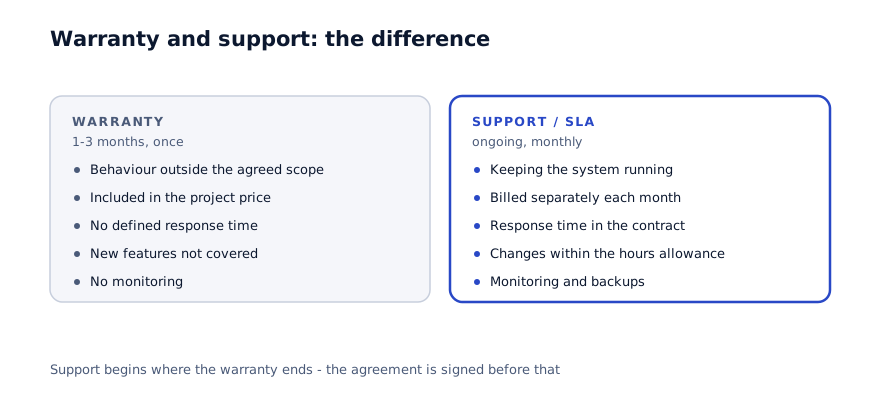
These two are frequently conflated, and that is exactly where disputes start.
| Warranty | Support (SLA) | |
|---|---|---|
| What it covers | Behaviour not matching the agreed scope | Keeping the system running |
| Duration | One to three months, once | Ongoing, monthly |
| Payment | Included in the project price | Billed separately each month |
| New features | Not covered | Within the included hours |
| Response time | Usually undefined | Specified in the contract |
| Monitoring | None | Included |
A warranty says "we stand behind the work we did". It covers technical defects and it is time-limited.
Support says "we are responsible for your system continuing to work". That is a different service: monitoring, backups, a fast response, small changes.
Support begins where the warranty ends. Without an agreement you move into a "whenever we can" arrangement.
What response time actually means
This is the headline figure in an SLA, and it needs to be read correctly.
Response time is the interval from a request arriving to a reply. It is not the time to resolve the problem.
Resolution time depends on complexity and is either agreed separately or not at all.
Workable tiers:
| Tier | Response time | Who it suits |
|---|---|---|
| Basic | 48 hours | System downtime does not stop work |
| Business | 24 hours | Used in day-to-day operations |
| Enterprise | 4 hours | System downtime stops production |
The choice is commercial rather than technical: what does a day without the system cost you? If the number is large, Enterprise is justified. If it is small, Basic is enough.
A practical calculation: how many people stop working during a day of downtime and what their hour costs. If a warehouse system goes down, twenty people are idle — that is $300–500 a day. Against that, an $800 monthly SLA looks inexpensive.
What belongs inside an SLA
Every tier should include these, and they belong in the contract:
- Response time in hours, specifying working days or 24/7
- Monthly hours allowance — how many are included
- Monitoring — is system health watched and are outages alerted
- Backups — how often and where they are stored
- Recovery time — how long restoration takes after a failure
- What is excluded — new modules, major changes, hardware
The fifth is often missing and it matters more than the rest. Backups exist, but restoring from them takes two days — in practice that is the same as having none.
The three-year total
This calculation belongs at proposal stage, not afterwards.
An example:
| Item | Amount |
|---|---|
| Project price | $28,000 |
| Support at $800 a month | |
| Support over 36 months | $28,800 |
| Three-year total | $56,800 |
Support cost more than the build. That is not a bad thing — the system ran and was maintained for three years. But the figure should be known in advance.
Comparing two proposals: one at $28,000 with $800 a month, another at $38,000 with $300 a month. Over three years the first is $56,800 and the second is $48,800. The cheaper-looking proposal turned out more expensive.
An alternative model: annual percentage
In some cases a percentage of project value replaces the monthly tier.
The usual rate is 18% a year. For a $70,000 system that is $12,600 a year, or $1,050 a month.
When it works better: on larger, more complex systems, particularly with many modules. A monthly tier is more precise for smaller systems.
Both models work — what matters is knowing which one applies and what it includes.
In-house team or external support
This question arrives as a company grows.
External support
$300-2,000 per month
- The team that built the system knows the code
- Several specialists: backend, frontend, DevOps
- Cover exists during holidays and illness
- Constraint: your queue is shared with other clients
In-house team
From $1,500 per month
- Always available and knows the business well
- Handles other internal work too
- A single person — holidays and illness become a problem
- Knowledge concentrates in one person and leaves with them
In practice a mixed arrangement often works best: an internal person handles day-to-day questions and training, while the external team takes technical work and development.
Clauses your contract needs
- Response time and how it is measured — which channel starts the clock
- Monthly hours and whether unused hours carry forward
- What is included and what is not — a specific list
- Monitoring and backup arrangements
- How and when the price may change
- Termination terms and how data is handed over
The last is forgotten most often. If you decide to change teams, how data, code and documentation transfer should be written down in advance.
The most common mistake
Not signing a support agreement and assuming you will "sort it out when needed". Negotiating during an incident is too late: the team is on another project, the price is under discussion, and your system is down throughout. The agreement should be signed before the warranty expires.
When support is not needed
For the sake of honesty this deserves saying.
If the system is simple, no changes are expected, and downtime has no serious effect on the business, a standing SLA is not essential. An hourly arrangement will cost less.
When that fits: a small internal tool, few users, a non-critical process.
When it does not: inventory, point of sale, production, payroll. When those stop, work stops.
In summary
Support is not an extra cost. It is what you pay for the system to keep running, and it belongs in the calculation alongside the project price.
Practical steps:
- Separate warranty and support clearly in the proposal
- Choose a response time by business impact rather than by price
- Calculate the three-year total: project plus 36 months of support
- Ask about recovery time, not just whether backups exist
- Sign the agreement before the warranty expires
- Write termination and data handover into the contract
Let us discuss support terms
In 30 minutes we tell you which tier suits your system and calculate the three-year total with you.
Discuss your project
Shahbozbek Usmonov
ShahNur Software team sharing lessons from building and running real products.
About the teamRelated articles

Procurement
7 clauses every software development contract needs
What to check before signing a development contract. Code ownership, scope, acceptance procedure and the places where disputes most often begin.
September 1, 20266 min read
Read more
Automation
Why systems go unused, and how to prevent it
Systems fail through non-adoption, not technology. Five real causes and what to do before the project, during it and after go-live.
September 10, 20268 min read
Read more
Procurement
Why a six-month project becomes an eighteen-month one
Five sources of overrun and how many weeks each one adds. Practical ways to hold a deadline and the warning signs visible before you start.
September 11, 20267 min read
Read moreHave a product idea? Let’s build it together.
Start a conversationOn this page