
ERP


On this page
This question comes up at the start of almost every ERP project, and it is usually answered the wrong way round.
The most common mistake runs in reverse: standard inventory accounting gets built from scratch, while the company's genuinely distinctive process is squeezed into an off-the-shelf template. Both cost money and time.
The short answer
One question decides it: does this process set you apart from competitors? If it does not, configure a ready system — three to four weeks and $7,000–12,000. If it does, build from scratch — fourteen to sixteen weeks and from $70,000. In most companies the answer is mixed: a ready core with one or two custom modules.
The question that decides it
Split your processes into three categories.
Standard processes. Payroll, cash handling, document flow, attendance. These are almost identical across companies and nobody competes on them. Building them from scratch is money spent for nothing.
Industry processes. Production norms, weighbridge control, warehouse structure. Similar within an industry, different outside it. A system built for your industry works here.
Your advantage. How you serve a client, how you calculate a price, how you assemble an order. If that process is what sets you apart in the market, do not force it into a template.
Configuring a ready system
3-4 weeks · $7,000-12,000
- The system already runs and has been proven in practice
- Lower risk — you can see the result before you commit
- Other companies' experience is built into it
- Constraint: you adapt to its existing logic
- New features arrive more slowly
Building from scratch
14-16 weeks · $70,000-90,000
- Everything is built around your way of working
- The process does not change — the system adapts
- Full control and unlimited extension
- Higher risk — the result appears at the end
- Three to five times more expensive and slower
The mixed option, which is the most common
In practice, for most companies the right answer sits in the middle.
The core comes from a ready system: inventory, cash, payroll, reporting. These are standard, and spending time on them makes no sense. On top of that, your own distinctive module is built from scratch.
Take a metal forming plant. Inventory, sales and payroll are ready-made. Cutting plan optimisation and waste accounting are custom, because that is exactly where the plant makes or loses money.
This approach cuts the price by a factor of two or three and shortens the timeline.
The decision matrix
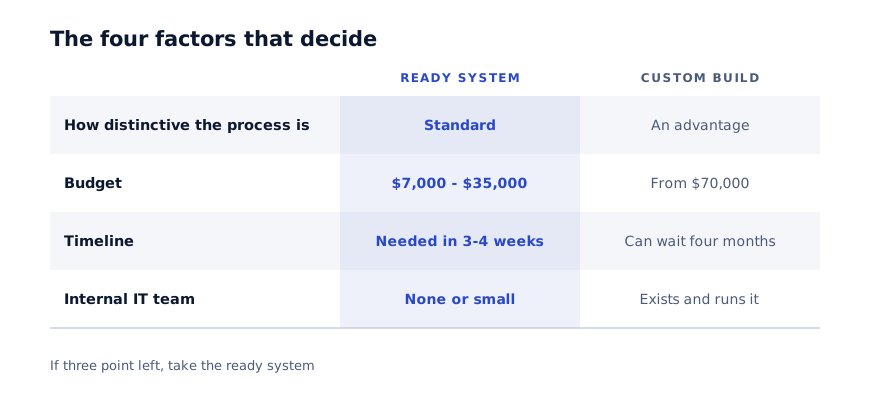
Assess four factors. If three point towards ready-made, take the ready system.
| Factor | Ready system | Custom build |
|---|---|---|
| How distinctive the process is | Standard | A competitive advantage |
| Budget | $7,000–35,000 | From $70,000 |
| Timeline | Needed in 3-4 weeks | Can wait four months |
| Internal IT team | None or small | Exists and will run the system |
Budget and timeline are often decisive. If the system is needed in three months, the custom option does not exist.
The hidden costs of a ready system
Ready-made does not always mean cheaper. Costs appear in three places.
- Adapting your process to the system requires retraining staff
- Every additional feature you need is a separately paid change request
- Dependency on the system owner if they raise prices or shut down
- In a multi-tenant system your request sits in a shared queue
- Difficulty of migrating data out later if you change direction
So when you evaluate a ready system, ask: who owns the code and the database, what happens if the system stops, and what an additional module costs.
The hidden costs of building from scratch
The other side has costs too, and they are usually left out.
Support. In a ready system it is priced in and shared across other clients. In a custom system support is yours alone — $300 to $2,000 a month.
Defects. New code always ships with defects. A ready system has been tested across dozens of companies; yours is tested only at yours.
Time. Four months is not simply waiting. Throughout it you keep working the old way, and the losses continue.
The most expensive mistake
Choosing a custom build and then asking for "the same thing the ready system does". That combines the worst of both options: you pay development prices and receive a copy of an existing product. If the ready system appeals to you, take the ready system.
How to test the decision
There are two practical steps before committing.
1. See the ready system running. Not a demo — a live system with real users. Talk to a client in your industry. Often at this point it becomes clear that the system covers eighty per cent of your process and the remaining twenty per cent does not matter.
2. Run a discovery stage. Two weeks, process analysis and a written document. At the end of it the choice becomes a calculation rather than an assumption. It costs $3,500 and it is needed either way.
In summary
The question is not technical, it is commercial: does this process set you apart or not.
A practical order:
- Split your processes into three categories: standard, industry, your advantage
- Consider a custom build only for the third category
- Cost the mixed option — a ready core with a custom advantage module
- Before choosing a ready system, see it running in real conditions
- Start with a discovery stage either way
Let us work out which route fits you
In a 30-minute call we review your process, and you leave with an indicative timeline and budget.
Discuss your project
Shahbozbek Usmonov
ShahNur Software team sharing lessons from building and running real products.
About the teamRelated articles

ERP
How much does an ERP cost in the GCC
What drives ERP pricing, which ranges are realistic, and what to do when the budget does not stretch. A concrete breakdown by modules, integrations and.
August 25, 20266 min read
Read more
Industry
Digitising a manufacturing operation: where to start
Which module to implement first in a plant, why product costing comes out wrong, and how a rollout actually runs. A practical order drawn from 37.
August 21, 20266 min read
Read moreHave a product idea? Let’s build it together.
Start a conversationOn this page