
Industry


On this page
Ask a plant owner what a unit of their product costs to make. In most cases the answer is approximate: "roughly this much."
That is not a knowledge gap. Product cost is assembled from four sources — inventory, production, labour and energy — and each is tracked in a different system or ledger. Bringing them together by hand takes days, and by the time it is done the number is already out of date.
This article sets out where to start when digitising a manufacturing operation.
The short answer. In a plant you start with inventory, then production, then payroll. Sales and CRM come last. The reason is straightforward: inventory data underpins product costing, and without costing every other figure is an estimate. On a ready system this takes three to four weeks at $7,000–12,000; built from scratch, fourteen to sixteen weeks from $70,000.
Five signs the time has come
- Product cost is unknown, or calculated once a month and late
- Stock figures are only reliable after a physical count
- You learn raw material has run out at the moment an order is placed
- Payroll depends on output but is calculated by hand
- Two departments quote different numbers for the same metric
Three of these mean a system is already needed. Five mean you are losing money every month without seeing it.
Which module comes first
This is where most implementations go wrong. Many start with CRM or sales because those are the most visible. In a plant the order is different.
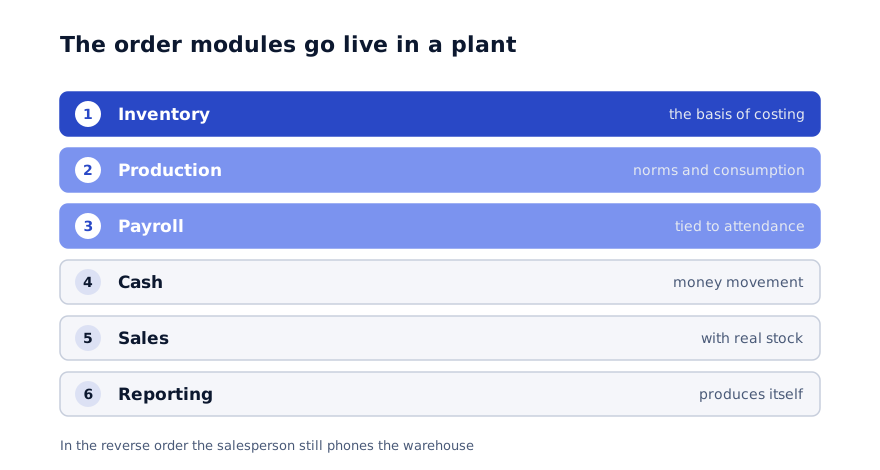
1. Inventory. The foundation for everything: raw material receipts, issues, balances and stocktaking. Without this data, product cost cannot be calculated.
2. Production. Plans, norms, material consumed and output produced. This is where cost becomes a real number rather than an estimate.
3. Payroll. Linked to attendance and output. This block usually saves the most time.
4. Cash and settlements. Money movement and receivables.
5. Sales and customers. Only now does the system see real stock and know real cost when an order is taken.
6. Reporting and analytics. Once the five above are running, reporting produces itself.
What happens in the reverse order: a polished CRM runs, but the salesperson still phones the warehouse to check stock.
Why product costing comes out wrong
This is the most expensive problem in manufacturing. There are three causes.
Material is valued at an old price. Stock consists of several batches, each bought at a different price. If the system does not record which batch was consumed, cost becomes approximate.
Waste and rejects are excluded. If eight per cent of metal is lost in cutting and that never reaches the calculation, cost lands below reality. You may be selling at a loss without knowing it.
Indirect costs are not allocated. Energy, workshop rent, equipment depreciation. They stay in a general pool and are never spread across products.
A practical test: calculate the cost of your three best-selling items two ways — from accounting records and from production records. If the gap is over ten per cent, you need a system. In our experience the gap is usually fifteen to twenty-five per cent.
The link between inventory and production
This is where the most data is lost in a plant.
How it should work: a production order is issued, material is written off against the norm, actual consumption is recorded, and the variance becomes visible. If the norm is 100 kg and 118 kg was actually used, that is a question worth asking. Equipment, material quality, or something else.
Seeing that variance is the single biggest benefit of the system. Eighteen per cent on one item looks trivial; across a month it becomes a serious figure.
Integrations specific to a plant
| What | Why | Timeline |
|---|---|---|
| Weighbridge | Every weighing is logged automatically and handwritten records disappear | 1-2 weeks |
| Cameras | Weighing and dispatch are documented with an image | 1 week |
| Accounting system | Operational records are separated from statutory reporting | 2-3 weeks |
| Electronic invoicing | Documents are generated automatically | 1-2 weeks |
| Attendance terminal | Payroll is tied to actual attendance | 1 week |
Weighbridge and camera integrations matter most: they take the data out of human hands. Disputes are then settled on the record rather than on memory.
How the rollout runs
Weeks 1-2. Understanding the process. Time on the shop floor, separate conversations with each department, collection of the forms in use. This stage usually reveals that part of the process is written down nowhere and lives in a few people's heads.
Weeks 3-4. Inventory module. The first block to go live, run in parallel with the old ledger for a month.
Weeks 5-8. Production and norms. The hardest stage, because norms are often undocumented and have to be established together.
Weeks 9-12. Payroll, cash, integrations.
Weeks 13-16. Reporting, training, full cutover.
Shop floor staff are both the largest risk and the largest opportunity. They may resist, because every action is now recorded. The answer is to involve one or two supervisors from the first day. They will adapt the interface to real working conditions and then train their colleagues themselves. A system designed from an office does not survive on the shop floor.
Three mistakes
Starting without norms. The production module rests on norms. If they are undocumented, they have to be established first — that is a process engineer's job, not the system's.
Implementing everything at once. Change is absorbed slowly in a plant. Stage by stage, with a month of parallel running at each step.
Building only for the office. The shop floor terminal has to be different: large buttons, few fields, usable with gloves on.
What it costs
$7,000-12,000Configured on a ready system, 3-4 weeks
$70,000-90,000Built from scratch, 6-10 modules, 14-16 weeks
A ready system fits most plants — processes in metal forming, furniture, food and building materials are broadly similar. Building from scratch is justified when your process is genuinely distinctive.
In summary
Digitising a plant starts with inventory, not CRM.
A practical order:
- Calculate the cost of three products two ways and look at the gap
- Start with the inventory module and run it in parallel for a month
- Document production norms — that is work before the system, not inside it
- Add weighbridge and attendance integrations early; they take data out of human hands
- Involve one or two shop floor supervisors from day one
A 30-minute review of your operation
We listen to your process, tell you which module is worth starting with, and you leave with an indicative timeline and budget.
Discuss your project
Shahbozbek Usmonov
ShahNur Software team sharing lessons from building and running real products.
About the teamRelated articles

Industry
A management system for a training centre
Groups, attendance, payments and the parent portal. Where students are lost and which module the rollout should start with.
September 17, 20266 min read
Read more
Industry
Inventory and POS system for a retail chain
Why stock never reconciles between branches, how to control receivables and which module to start with. A practical order for the rollout.
September 9, 20266 min read
Read more
Industry
ERP for sheet metal and roofing profile manufacturers
Cutting plans, waste accounting and coil control. The industry-specific processes and a practical order drawn from 37 implementations.
September 4, 20266 min read
Read moreHave a product idea? Let’s build it together.
Start a conversationOn this page