
Industry


On this page
One shop is straightforward to run. When the second branch opens, a question appears: how much sits in the central warehouse and how much sits in the branches.
After the third branch, answering that takes several hours. After the fifth, the answer stops being reliable at all.
The problem is not the number of branches. It is how data moves between them.
The short answer
In a retail chain the system has to connect three things: the central warehouse, branch stock and the till. Kept apart, each branch runs its own records and head office never sees the real position. On a ready system this is three to four weeks and $7,000–12,000; a full chain system is fourteen to sixteen weeks and from $70,000.
Three main pain points
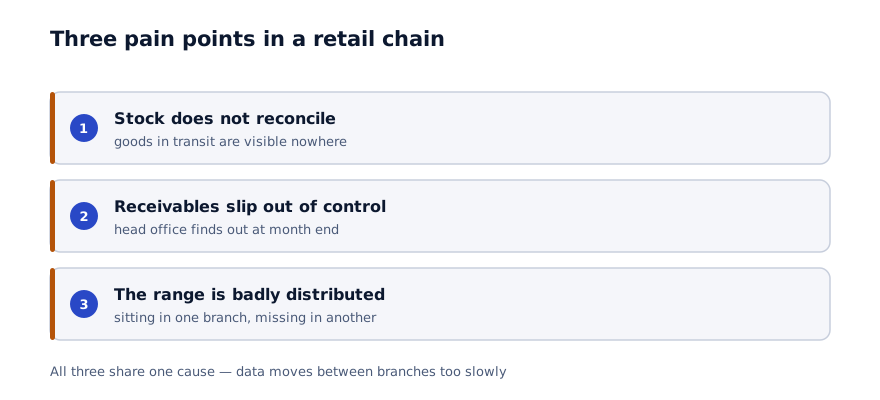
Stock does not reconcile. One figure at head office, another at the branch. The cause: transferred goods are recorded in two places at different times, and goods in transit are visible nowhere.
Receivables slip out of control. Where credit sales exist, who owes what is tracked at branch level. Head office learns the total only at month end, and by then the limit has often already been passed.
The range is distributed badly. An item sits in one branch while another runs out of it. Transfer decisions are made by hand and usually too late.
Where it starts
The order matters, because each module rests on the one before it.
01
Central warehouse
Receipts, balances and dispatch to branches. This is the foundation — without it branch stock is meaningless.
02
Inter-branch transfers
Goods in transit carry their own status: dispatched, received. This is where discrepancies are found.
03
Till and sales
A recorded sale reduces stock automatically. Double entry disappears.
04
Customers and receivables
Credit terms, payment schedules and limits. The system warns as a limit is approached.
05
Reporting and range
Turnover by branch, slow-moving stock, lines that keep running out.
The second step is the one most often skipped. If goods in transit have no status of their own, a discrepancy during transfer can never be traced.
Inter-branch transfers
This is the most delicate part of a retail chain, so it is worth setting out separately.
The correct process has three stages:
Dispatch. Head office issues the goods. In the system they move to "in transit" — no longer at the centre, not yet at the branch.
Receipt. The branch counts the goods and confirms in the system. If quantities differ, the discrepancy is captured at this point.
Closing. Where there is a difference, a reason is recorded: under-dispatched, lost in transit, or miscounted.
Without those three stages a discrepancy becomes a general shortfall and its source is never established.
The most common mistake
Giving branches separate systems. Each branch works in its own database and head office assembles reports at month end. That holds for a few branches and then control disappears entirely. There should be one database, with each branch getting its own view of it.
Receivables control
Where credit sales are common, this is the largest hidden risk.
The system needs to cover four things:
- A limit per customer — both amount and term
- A warning as the limit is approached, not after it is exceeded
- A payment schedule and days overdue
- Receivables by salesperson — who extended how much credit
- Total receivables by branch and their ratio to turnover
The fourth is frequently missing and it matters. If the salesperson decides on credit, the outcome of that decision should be visible against them.
Range: slow-moving stock
This is the quietest way to lose money in retail.
An item sits in one branch for three months while another branch runs out of the same line. Both are losses: money frozen in the first case, a sale lost in the second.
The system surfaces it:
| Metric | What it shows |
|---|---|
| Turnover rate | How many days a line takes to sell |
| Slow-moving stock | No movement for over 60 days |
| Imbalance between branches | Surplus in one place, shortage in another |
| Expiry control | Lines approaching their date |
These four reports usually pay for themselves in the first month, because the value of slow-moving stock turns out larger than expected.
Till integration
A technical question, but one to settle early.
Two options:
Till inside the system. Sales are recorded directly and stock updates instantly. Requirement: the till must meet local fiscal regulations and work with the required fiscal module.
Integration with your existing till. You already have till software that works. In that case a data exchange is configured, usually daily or in real time.
The second is cheaper but introduces a lag. Which one fits is settled during discovery.
What to measure
Record these at the start of the project:
| Metric | Why it matters |
|---|---|
| Stocktake variance by branch | Direct money |
| Total receivables and the overdue share | Hidden risk |
| Value of slow-moving stock | Frozen cash |
| Time to establish a stock figure | Daily efficiency |
| Cases of promising stock you did not have | Lost sales |
The last one is hard to measure, but ask your salespeople and they will tell you precisely.
What it costs
$7,000-12,000On a ready system, 3-4 weeks
$70,000-90,000Many branches and a complex range, 14-16 weeks
The number of branches affects price, but not linearly. The second branch costs considerably less than the first, because the core work is done once. Where each branch runs its own process, separate configuration is required.
In summary
In a retail chain the problem is not the number of branches. It is how data moves between them.
Practical steps:
- Break down your last stocktake variance by branch — see where it concentrates
- Start with the central warehouse; branch stock depends on it
- Split transfers into three stages: dispatch, receipt, closing
- Show credit limits at salesperson level too
- Switch on the slow-moving stock report in the first month
Let us review your retail operation
In 30 minutes we identify where stock and receivables are slipping out of control, and you leave with an indicative timeline and budget.
Discuss your project
Shahbozbek Usmonov
ShahNur Software team sharing lessons from building and running real products.
About the teamRelated articles

Automation
Warehouse automation: from the ledger to real time
Why stock figures never match, whether barcodes are actually needed, and how a rollout runs. A practical way to reduce your stocktake variance.
September 2, 20266 min read
Read more
ERP
How much does an ERP cost in the GCC
What drives ERP pricing, which ranges are realistic, and what to do when the budget does not stretch. A concrete breakdown by modules, integrations and.
August 25, 20266 min read
Read more
Industry
A management system for a logistics company
Weighbridge, fleet and contracts in one system. Where cargo data goes missing, why camera integration matters, and the order a rollout should follow.
August 29, 20266 min read
Read moreHave a product idea? Let’s build it together.
Start a conversationOn this page