
Automation


On this page
There is one question people ask about a warehouse more than any other: "how much do we have left?"
And there is one answer they hear more than any other: "let me check."
That check takes anything from a few minutes to a few hours. During it your salesperson is holding a client on the line, and the client is calling a competitor.
The short answer
The purpose of warehouse automation is not reporting — it is capturing stock at the moment it moves. If data is entered on receipt and on issue, the balance reconciles itself. On a ready system this is three to four weeks and $7,000–12,000. Barcodes are not needed by everyone; it depends on the size of your catalogue.
Why stock figures never match
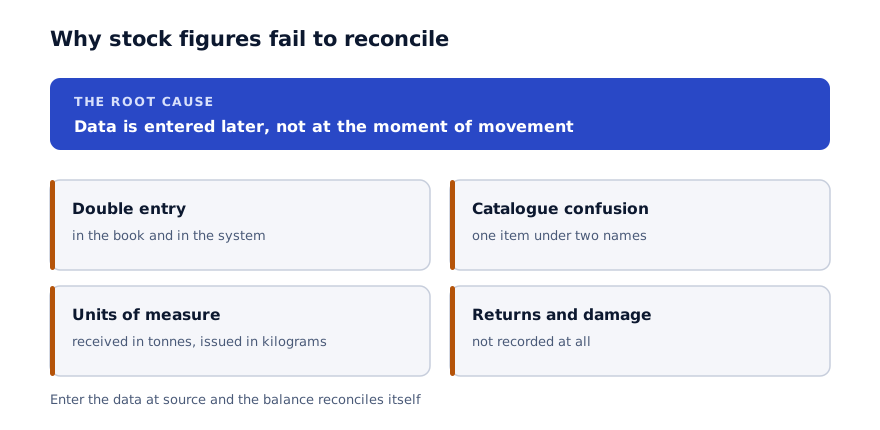
The cause is almost always the same: data is entered later, not at the moment of movement.
Goods arrive, the storekeeper writes it in a book. That evening or the next day the records go to accounting, and someone enters them into the system. Throughout that window the balance is wrong.
Four things compound it:
Double entry. The same figure is written in a book and again in the system. Every extra point of entry raises the chance of an error.
Catalogue confusion. One item is held under two names. Two records exist, and the balance is split between them.
Units of measure. Received in tonnes, issued in kilograms. The conversion is done by hand and is not always right.
Returns and damage. These are often not recorded at all, and reappear at stocktake as a shortfall.
What automation changes
The core change is one thing: data is entered at source.
The storekeeper records it themselves as goods are received, through a phone or terminal. The accounting step disappears and the balance updates the same minute.
Everything else follows from that:
| What | How it changes |
|---|---|
| Stock levels | Live, without phoning the warehouse |
| Reservations | Stock is allocated automatically when an order is entered |
| Stocktake | The cause of a variance is visible, because every movement is logged |
| Expiry control | Goods approaching expiry raise a warning in advance |
| Minimum stock | An alert fires when the threshold is reached |
The last two are often overlooked, and they are the parts that save money.
Are barcodes necessary
The most common technical question, and the answer is not the same for everyone.
Yes: if the catalogue exceeds five hundred lines, if items look alike, or if batch and expiry control is required.
No: if you hold under a hundred lines and items are visually distinct. Selecting from a list will be faster.
The middle option: barcodes on the fifty fastest-moving lines, a list for the rest. Practical and inexpensive.
A dedicated scanner is not required — a phone camera works. The mobile app reads the code and finds the item. Separate hardware is only justified at hundreds of scans a day.
How the rollout runs
01
Clean the catalogue
Merge duplicate records and standardise units of measure. This is work before the system, and it takes the longest.
02
Opening stocktake
Count actual stock and enter it. This is the baseline — from here every movement is recorded.
03
Receipts and issues
The storekeeper begins entering directly. Run in parallel with the book for a month.
04
Connect to sales
Reservation triggers when an order is entered. Sales staff see stock themselves.
05
Reporting and alerts
Minimum stock, expiry control, turnover analysis. The system now tells you.
The first step is the one most often skipped, and it is the one that breaks projects. Put a confused catalogue into a system and you get a digitised version of the confusion.
Will the storekeeper resist
Yes, and it is natural. The reason is not technical.
Previously only they knew the true balance, and that gave them a certain standing. Now every movement is visible, and it feels like surveillance.
What works:
Start by making their job easier. Fast search, the system shows the storage location, documents generate themselves, no report to assemble at month end.
Test the terminal with them. Warehouse conditions differ from an office: gloves, dust, poor lighting. Large buttons and few fields are required.
Run in parallel for a month. The book is not removed on day one. That builds confidence and surfaces errors.
The most common mistake
Building the system for management only. A polished dashboard, detailed reports — and an interface the storekeeper finds awkward. They carry on the old way, data arrives second-hand, and you have a system but the same problem.
What to measure
Record these figures at the start of the project. Measure them again after three months.
- Stocktake variance, as a percentage and as a value
- Time spent establishing a stock figure
- How often per month you promise stock you do not actually have
- Value of goods written off for expiry
- Time to prepare the monthly warehouse report
The first metric matters most. Stocktake variance is money, and it is usually the number nobody calculates.
What it costs
$7,000-12,000On a ready system, 3-4 weeks
$28,000-35,000With your own specifics, built from scratch, 8-10 weeks
For most companies the first option is enough — warehouse processes are broadly similar everywhere. A custom build is justified only for particular requirements: complex batch control, or integration with automated storage equipment.
Cleaning the catalogue is normally not in the price and stays on your side. Plan for it — it is several days of work.
In summary
Warehouse automation starts at the point of data entry, not at reporting. If the storekeeper enters it, the balance reconciles.
Practical steps:
- Find the variance from your last stocktake — that is your baseline
- Clean the catalogue; that is work before the system
- Choose the terminal with the storekeeper, not in an office
- Decide on barcodes by catalogue size, not by fashion
- Run in parallel with the book for a month
Let us review your warehouse process
In 30 minutes we identify where the balance breaks down, and you leave with an indicative timeline and budget.
Discuss your project
Shahbozbek Usmonov
ShahNur Software team sharing lessons from building and running real products.
About the teamRelated articles

Industry
Digitising a manufacturing operation: where to start
Which module to implement first in a plant, why product costing comes out wrong, and how a rollout actually runs. A practical order drawn from 37.
August 21, 20266 min read
Read more
ERP
How much does an ERP cost in the GCC
What drives ERP pricing, which ranges are realistic, and what to do when the budget does not stretch. A concrete breakdown by modules, integrations and.
August 25, 20266 min read
Read more
Industry
A management system for a logistics company
Weighbridge, fleet and contracts in one system. Where cargo data goes missing, why camera integration matters, and the order a rollout should follow.
August 29, 20266 min read
Read moreHave a product idea? Let’s build it together.
Start a conversationOn this page