
Industry


On this page
In logistics, most disputes come down to a single number: how much cargo went out and how much arrived.
The shipper quotes one figure, the receiver another. Both have paperwork, and each set of paperwork says something different. And there is no record left to establish who is right.
This article looks at that problem and at the system that closes it.
The short answer
In logistics the system starts at the weighbridge. Once every weighing is captured automatically and stored with an image and a timestamp, half the disputes disappear. Fleet, contracts and settlements come after. On a ready system this is three to four weeks and $7,000–12,000; a full enterprise system is fourteen to sixteen weeks and from $70,000.
Where the data goes missing
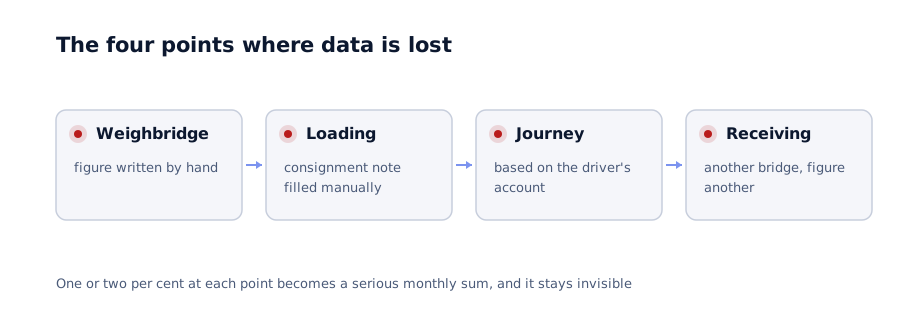
There are four points in practice, and data is distorted at each of them.
The weighbridge. The figure is written on paper by hand. It cannot be verified afterwards, because the moment of weighing was never recorded anywhere.
Loading. What actually went onto the vehicle is shown only by the consignment note, which is also filled in by hand.
The journey. Where the vehicle is and when it arrived rests on the driver's account.
Receiving. The receiver weighs on their own bridge and gets a different figure. Who absorbs the difference is unclear.
If each point carries a one or two per cent gap, across a month that becomes a serious sum. And it stays invisible, because there is nothing to compare against.
What the system changes
Weighbridge integration. The weighing is captured automatically. The figure is not typed in — it comes directly from the bridge.
Cameras. Every weighing is documented with an image: vehicle plate, time, weight. Disputes are then settled on the record rather than on memory.
Vehicle access. Entry and exit times are logged. Who arrived when, how long they waited — all of it sits in the system.
Link to contracts. Each weighing is attached to a contract. Month-end settlement is produced automatically rather than assembled by hand.
Reporting. Daily and monthly volume by client, by vehicle and by route.
Which module comes first
01
Weighbridge and cameras
First priority. These two take the data out of human hands and close the main source of disputes.
02
Fleet and access control
Entry, exit and waiting time. The real duration of loading becomes visible.
03
Contracts and clients
Each weighing attaches to a contract and the tariff applies automatically.
04
Settlements
Monthly billing is generated by the system. Manual assembly disappears.
05
Reporting and analytics
Figures by route, client and vehicle. Decisions rest on data.
The order is not arbitrary. Weighbridge data underpins everything else — if it is wrong, the settlement is wrong too.
On camera integration
This is the part that raises the most questions, so it is worth explaining separately.
The camera captures an image at the moment of weighing and attaches it to the record. Any weighing can then be opened and the image reviewed: which vehicle, when, how much.
Why it matters: when a dispute arises, you have evidence. If a client says "we dispatched 22 tonnes", you open the record and show the plate, the timestamp and the bridge reading on one screen.
Technically this is not complex. Most industrial cameras stream over the network and the system stores the frame. It is usually a week of work.
The most common mistake
Designing the system from an office. The weighbridge operator works in gloves, the screen is covered in dust, and the job has to be quick because a vehicle is waiting. An interface designed for an office does not survive there. The terminal is built separately: large buttons, few fields, three or four steps to completion.
What to measure
Record the current state at the start of the project. Measure the same figures again a month after launch.
| Metric | How it usually moves |
|---|---|
| Disputes over weighing | Falls noticeably — there is a record |
| Time per vehicle | Shortens — no handwritten entries |
| Preparing monthly settlement | From several days to several hours |
| Errors in reporting | Fall — data is entered once |
| Lost consignment notes | Disappear — everything is in the system |
Quoting a specific percentage in advance would be dishonest, because it depends on where you start. That is precisely why recording the baseline matters.
Which option fits
Configuring a ready system
3-4 weeks · $7,000-12,000
- Weighbridge, fleet and contract control are standard
- Launched on the UZTAROZI+ base
- Camera integration is included
- Lower risk — the system runs for 500+ users
Building from scratch
14-16 weeks · $70,000-90,000
- Many branches and a complex route network
- Cross-border transport and customs documentation
- Your own tariff calculation logic
- Deep integration with other systems is required
For most regional logistics operators the first option is enough. The second becomes relevant with cross-border transport and multiple branches.
A checklist for proposals
Ask these when you receive a quote:
- Does it work with my weighbridge model — name the model and get confirmation
- Is camera integration in the price or quoted separately
- Is the terminal interface adapted to weighbridge conditions
- Does the system work if the connection drops, and is data lost
- Can I change tariff rules myself
- Is there a data export option
The fourth question matters: connectivity at a weighbridge is often unstable. The system has to work offline and synchronise once the connection returns.
In summary
In logistics the system starts at the weighbridge, not at reporting. If the data is captured correctly at source, everything downstream falls into place.
Practical steps:
- Count weighing disputes for one month — that is your baseline
- Start with weighbridge and camera integration, add the rest later
- Test the terminal interface with the operator, not in the office
- Insist on offline mode
- Run in parallel with the old process for a month
Let us review your logistics process
In 30 minutes we identify where the data is being lost, and you leave with an indicative timeline and budget.
Discuss your project
Shahbozbek Usmonov
ShahNur Software team sharing lessons from building and running real products.
About the teamRelated articles

Industry
Digitising a manufacturing operation: where to start
Which module to implement first in a plant, why product costing comes out wrong, and how a rollout actually runs. A practical order drawn from 37.
August 21, 20266 min read
Read more
ERP
How much does an ERP cost in the GCC
What drives ERP pricing, which ranges are realistic, and what to do when the budget does not stretch. A concrete breakdown by modules, integrations and.
August 25, 20266 min read
Read more
ERP
Moving from accounting software to an ERP
Whether to replace your accounting system or run it alongside an ERP. What each system is for, how migration runs, and the mistakes that cost the most.
August 28, 20266 min read
Read moreHave a product idea? Let’s build it together.
Start a conversationOn this page