


On this page
The honest answer to "how much does an ERP cost" is: not known yet.
That is not evasion. An ERP is not a boxed product — it is a system built around your process. The number of modules, the integrations, the entities and the volume of data move the price by a factor of three to five.
But the ranges exist and they are not secret. This article sets them out and explains what moves the final figure.
The short answer. For Gulf projects: configuring a ready system runs $7,000–12,000 over three to four weeks; a company-wide system built from scratch runs $70,000–90,000 over fourteen to sixteen weeks. Which end of the range you land on is decided by four things: number of modules, integrations, entities and the volume of data migration.
Three ranges
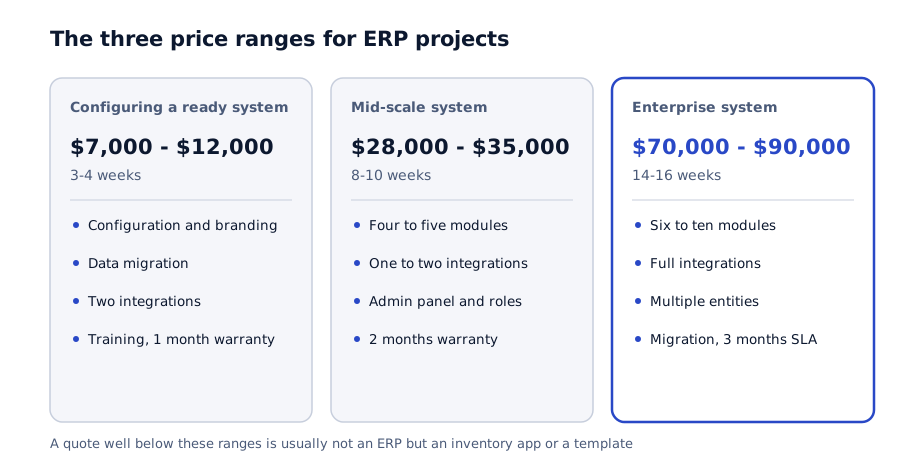
In practice ERP projects fall into three groups.
Configuring a ready system — $7,000–12,000, three to four weeks. When your process is standard. The system is already running and has been proven in other companies. Configuration, data migration, two integrations and training are included.
Mid-scale system — $28,000–35,000, eight to ten weeks. Your process has genuine specifics, but the company is not large. Four or five modules, one or two integrations.
Enterprise system — $70,000–90,000, fourteen to sixteen weeks. Six to ten modules, multiple entities or branches, complex production, or the consolidation of several existing systems. Migration and an SLA are included.
Anything well below these ranges — an "ERP" for $5,000 — is not an ERP. Usually it is an inventory application or a template with the word ERP attached to it.
What moves the price
Four factors, in order of impact.
1. Number of modules. Each additional module adds one to three weeks. Inventory and sales are the most straightforward. Production and payroll are the hardest, because they depend on norms and on local regulation.
2. Integrations. One to three weeks each. Accounting systems, payment gateways, weighbridges, cameras, telephony. The third stage — handling failures — takes the longest.
3. Number of entities. One entity and five entities are not the same price. If each runs its own process, that is separate configuration and separate testing.
4. Data migration. Clean data takes a week. Messy data — duplicates, empty fields, wrong codes — takes three, plus the cleaning work itself.
When you receive a proposal, ask for migration to appear as its own line. If it is covered by a general phrase such as "included in the project", the argument comes later. In our experience migration accounts for ten to twenty per cent of project scope.
Does the number of users affect the price
This comes up often, because international ERP vendors sell per-user licences.
In our model, no. The price depends on the work to be delivered, not on how many people log in. Twenty employees and two hundred use the same system.
What does affect it is the number of roles. If the system has ten distinct roles and each sees a different screen, the amount of work rises. Three or four roles is standard.
What is not in the budget
Ask about these separately — they are almost never in the project price:
- Servers or cloud hosting, $50–300 a month
- Third-party service licences
- SMS gateway and payment processor commissions
- E-invoicing or compliance service fees where applicable
- Retraining when staff turn over
- Content entry and initial data loading
The sums are small individually, but unaccounted for they surface as surprises at the end of the project.
Support is the most overlooked line
The project price is one-off; support is permanent. Over three years, support can cost more than the build itself.
Two models:
| Model | How it works | Who it suits |
|---|---|---|
| Monthly SLA | $300 to $2,000 depending on response time and included hours | When you need a predictable budget |
| Annual percentage | 18% of project value per year | Easier for larger systems |
When you receive a proposal, ask what support costs after the first year. That figure is usually left unsaid.
When the budget does not stretch
This is a normal situation and it has a solution. Do not ask for a discount — split the scope into phases.
Phase 1. The two modules causing the most pain. Usually inventory and sales; in manufacturing, inventory and production.
Phase 2. Run them for three months. Measure the result: time saved, errors reduced.
Phase 3. Fund the next modules from the outcome of the first phase.
This has two advantages: the budget is split, and you test the team before committing serious money.
Why quotes for one project differ five-fold
Because the word "ERP" covers different things. Before comparing, level the proposals:
| Question | Why it matters |
|---|---|
| How many modules are included? | Three modules and eight cannot cost the same |
| Is migration included? | The most commonly omitted line |
| How many integrations are included? | "Required integrations" is the start of a future dispute |
| How many months of warranty? | This can be the main difference between two quotes |
| What does support cost? | Calculate the three-year total |
| Who owns the code? | Is the transfer after payment written into the contract |
After those six questions, a $22,000 and a $48,000 proposal will look far closer. Or the reason for the gap becomes clear.
In summary
An ERP price is not printed on a box — it depends on your process. But the ranges are known and they are not hidden.
Practical steps:
- Decide which modules belong in phase one — start with two
- List the systems you already run; they determine integration cost
- Insist that migration and support appear as separate lines
- Calculate the three-year total, not just the project price
- For an exact figure, start with a discovery stage — two weeks and a written document
A 30-minute assessment of your project
We review your process, tell you which modules to start with, and you leave with an indicative timeline and budget.
Discuss your project
Shahbozbek Usmonov
ShahNur Software team sharing lessons from building and running real products.
About the teamRelated articles

From spreadsheets to an ERP: when it is time to move
When spreadsheets are enough and when they start costing you. Seven signs, the intermediate options, and a practical order for the move.

Moving from accounting software to an ERP
Whether to replace your accounting system or run it alongside an ERP. What each system is for, how migration runs, and the mistakes that cost the most.

12 questions to ask before choosing an ERP vendor
The questions to put to every vendor. They prevent scope creep, budget overruns and the outcome where a system is delivered but never actually used.
Have a product idea? Let’s build it together.
Start a conversationOn this page