
ERP


On this page
Choosing an ERP usually starts with presentations. Every vendor shows polished slides, says they can do everything, and quotes a price.
The problem is that everyone looks good in a presentation. The difference shows up later — in the middle of the project, and especially after handover.
The questions below surface that difference in advance. Put them to every vendor and write the answers down.
The short answer
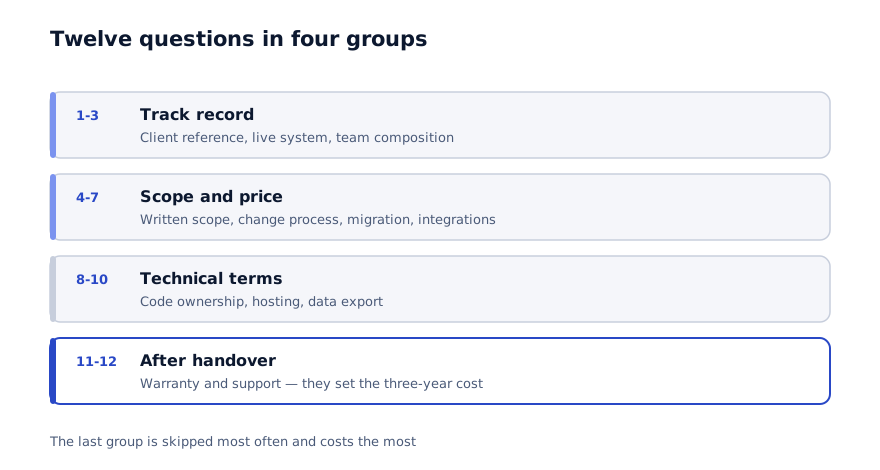
Twelve questions in four groups: track record, scope, technical terms, and life after handover. The last group is the one most often skipped, and it is the group that determines your three-year total cost. If three questions go unanswered, think twice before working with that vendor.
Group 1: track record and proof
1. Do you have a client in my industry, and may I speak with them?
The strongest question of the twelve. "Not possible, confidentiality" tells you a great deal. A good vendor hands over a client contact, because that client is satisfied.
2. Can you show me a live system rather than a demo?
A demo always looks good: the data is clean, nothing fails, every button works. A live system with real users shows the actual state of things.
3. Who exactly will work on this project?
Does the person you are speaking to write code, or are they in sales only. Ask for the team composition: how many engineers, whether they are committed to other projects, and who the project manager will be.
Group 2: scope and price
4. Will the scope be attached to the contract in writing?
If the answer is "we will clarify as we go", the project will run over. That is not an opinion but a pattern: projects started without a fixed scope almost always exceed budget.
5. How are changes beyond the scope handled?
A good answer: each change is quoted separately, its cost and schedule impact are stated in writing, and work begins after you approve it. A poor answer: "sure, we will add that" — the start of a future dispute.
6. Is data migration included in the price?
The most commonly omitted line. Migration accounts for ten to twenty per cent of project scope. It should appear as its own line rather than hiding inside a general "included in the project".
7. How many integrations are included, and are they named?
"Required integrations" is a vague phrase. Each integration is one to three weeks of work. They should be listed by name: accounting system, payment gateway, weighbridge, telephony.
Group 3: technical terms
8. Who will own the code and the database?
Is the transfer after full payment written into the contract. It is a single clause, but without it you cannot change vendors and every future change sends you back to the same door.
9. Where is the system hosted, and who manages the server?
On your infrastructure or theirs. If theirs, establish how you retrieve your data when the contract ends. Ask this early or you will find yourself locked in.
10. Can data be exported?
Every system needs an exit route. If data can only be viewed on screen and there is no export, that is a hidden dependency.
Group 4: life after handover
This group is skipped most often, and it is the one that determines your three-year cost.
11. How many months of warranty, and what does it cover?
Establish both the period and its boundary: technical defects are covered, new feature requests are not. The main difference between two proposals is frequently found here.
12. What does support cost and what is the response time?
The monthly figure and the response time should both be specific. Calculate the three-year total: project price plus thirty-six months of support. A cheap project sometimes arrives with expensive support.
A bonus question
"What will you do if my staff do not start using the system?" The answer reveals a vendor's experience immediately. An inexperienced team says "we will train them". An experienced one describes a plan for involving your people during the project — because they know systems fail through non-adoption, not through technology.
How to compare the answers
Write the answers down and put them in a table. Compare content, not price.
| What to compare | Why |
|---|---|
| Number of modules included | Three modules and eight cannot cost the same |
| Whether migration is a separate line | If not, an extra invoice arrives later |
| Whether integrations are named | The word "required" is a source of disputes |
| Months of warranty | One month and three months is a real gap |
| Three-year support total | Sometimes exceeds the project price |
After those five columns, a $22,000 and a $48,000 proposal will look far closer together. Or the reason for the gap becomes obvious.
The evaluation process
01
Long list
Request proposals from four or five vendors. Send every one of them the same brief.
02
Twelve questions
Put the questions to each vendor and record the answers.
03
References
Speak to clients of two vendors and see a live system.
04
Short list
Choose two and discuss the scope with them in detail.
05
Discovery
With the winner, start with a paid analysis stage — the price becomes firm after it.
What not to do
- Choosing on price alone — a cheap proposal means less work, not better value
- Trusting the presentation — do not decide without seeing a live system
- Signing a contract without a written scope — the main cause of overruns
- Not asking what support costs — over three years it can exceed the project
- Skipping the reference call — the cheapest check available to you
In summary
A good vendor does not avoid these questions. They welcome them, because the questions are where their advantage shows.
A practical order:
- Write down the twelve questions and put them to every vendor
- Put the answers in a table — compare content, not price
- Speak to clients of at least two vendors
- Calculate the three-year total: project plus thirty-six months of support
- Start with a discovery stage once you have chosen
We will answer all of these
In a 30-minute call we answer every one of the twelve questions, and you leave with an indicative timeline and budget.
Discuss your project
Shahbozbek Usmonov
ShahNur Software team sharing lessons from building and running real products.
About the teamRelated articles

ERP
How much does an ERP cost in the GCC
What drives ERP pricing, which ranges are realistic, and what to do when the budget does not stretch. A concrete breakdown by modules, integrations and.
August 25, 20266 min read
Read more
ERP
Off-the-shelf ERP or custom build: which one fits you
Configure a ready system or build from scratch — which is cheaper and safer. The single question that decides it, and what each choice costs you.
August 26, 20265 min read
Read more
Procurement
How much does custom software development cost in the GCC
Why quotes for the same project differ five-fold, what the price is actually made of, and how to compare proposals. Real ranges for Gulf enterprise projects.
August 20, 20267 min read
Read moreHave a product idea? Let’s build it together.
Start a conversationOn this page