
Industry


On this page
In sheet metal production, product cost comes out two different ways: the figure in the accounts, and the reality on the shop floor.
The gap is usually fifteen to twenty-five per cent, and it comes from one place — offcut.
When a coil is cut, material is left over. If it is not accounted for, cost appears lower than it is. Some orders are then produced at a loss and nobody notices.
The short answer
In this industry a system has to cover three things: coil-level inventory, cutting plans and waste capture. Without them, product cost stays an estimate. On a ready system this is three to four weeks and $7,000–12,000; built from scratch, fourteen to sixteen weeks and from $70,000.
Four industry-specific processes
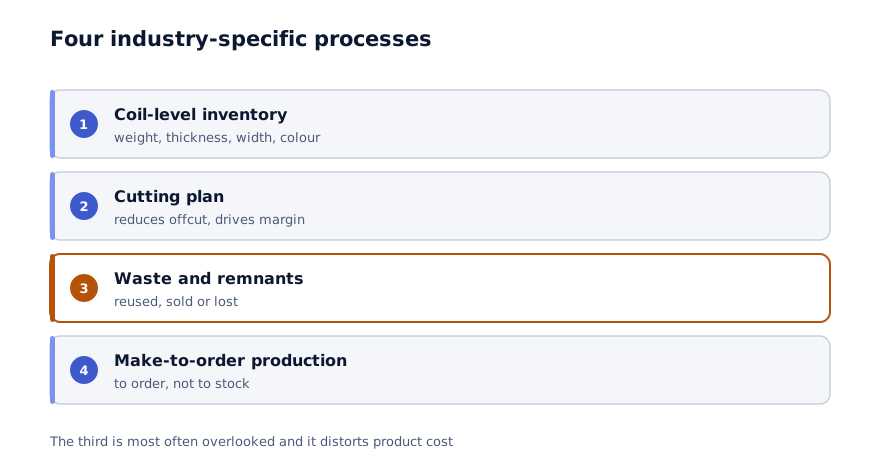
A generic ERP does not fully work here. The reason is four processes that do not appear in other sectors.
Coil-level inventory. Raw material arrives as coils, not units. Each coil has its own weight, thickness, width and colour. Inventory has to be tracked at that level, or the stock figure becomes meaningless.
Cutting plans. Order dimensions do not match coil width. The better the plan, the less offcut. This process affects margin directly.
Waste and remnants. Where material goes after cutting: reused, sold or lost. In many plants it is not recorded at all.
Make-to-order production. You produce to order, not to stock. Every order has its own dimensions, colour and deadline.
Why costing comes out wrong
Three causes, working together.
Offcut is excluded. If eight per cent is lost in cutting and never reaches the cost calculation, you are selling eight per cent cheaper than you believe.
Coil price is averaged. Stock holds several batches bought at different prices. If the system does not record which coil was consumed, cost becomes an average that sits well away from reality.
Rework is not captured. When something is rejected it gets made again. That is a second consumption of material and time, and it is usually never charged back to the original order.
A practical test: weigh a month of offcut across your three best-selling profiles and multiply by material cost. That figure is usually larger than anyone expects.
What the system provides
| Process | Without a system | With a system |
|---|---|---|
| Coil stock | Total tonnage | Each coil separately: weight, thickness, colour |
| Cutting plan | In the supervisor's head | The system proposes options |
| Waste | Not recorded | Captured per order |
| Product cost | Monthly and approximate | Per order and actual |
| Order status | Established by phone | Visible on screen |
| Payroll | Calculated by hand | Tied to output |
The largest change is in the fourth row. Knowing real cost changes how you price — which orders are profitable and which are not becomes visible.
How the rollout runs
01
Catalogue and coil records
A record for each coil type: thickness, width, colour, coating. This is work before the system and takes the longest.
02
Inventory module
Coil receipts, balances and consumption. Run in parallel with the old ledger for a month.
03
Production and norms
Orders, cutting plans, standard and actual consumption. The hardest stage, because norms are often undocumented.
04
Cost calculation
Including offcut and rework. The actual cost of every order becomes visible.
05
Sales and payroll
Real stock is visible when taking an order, and payroll ties to output.
A separate interface for the shop floor
This is the part most often overlooked, and it is what breaks projects.
The terminal on the floor has to differ from an office computer:
- Large buttons — pressed with gloves on
- Few fields — the task completes in three or four steps
- Contrast readable in poor lighting
- Continues working when the connection drops, syncing afterwards
- Hardware tolerant of dust and humidity
A polished interface designed from an office does not survive on the floor. The supervisor carries on the old way, data arrives second-hand, and the system loses its purpose.
The most common mistake
Starting without norms. The production module rests on standard consumption — how much material goes into how much output. If those figures are undocumented, they have to be established first. That is a process engineer's job, not the system's, and it takes several weeks. Fold it into the project and the timeline stretches.
What to measure
Record at the start of the project and measure again after three months:
| Metric | Why it matters |
|---|---|
| Offcut percentage | Direct money |
| Gap between accounting and production cost | Fifteen to twenty-five per cent at the outset |
| Stocktake variance | Whether coil-level tracking is working |
| Order lead time | The gap between plan and actual |
| Time to produce monthly reporting | Usually falls from a day to a few hours |
The first two are the important ones. They point straight at money.
Ready system or custom build
Processes in this industry are fairly similar across plants: coil, cutting, waste, order. A ready system therefore fits most of them.
Configuring a ready system
3-4 weeks · $7,000-12,000
- Coil tracking and waste capture are already built
- Launched on the TunkaForm base
- The experience of 37 plants is built into it
- Lower risk — the system is already running
Building from scratch
14-16 weeks · $70,000-90,000
- If cutting optimisation logic is your own
- If direct connection to machinery is required
- If there are many sites and a complex network
- If deep integration with other systems is needed
A custom build is justified only where cutting optimisation is your competitive advantage. In most plants it is a standard process.
In summary
In sheet metal production the system starts at the coil and is settled at the offcut.
Practical steps:
- Weigh a month of offcut and convert it into money
- Calculate the cost of three products two ways and look at the gap
- Prepare coil records — that is work before the system
- Document your norms; that is a process engineer's task, not the system's
- Test the shop floor terminal together with the supervisor
A 30-minute review of your plant
We listen to your process, show where offcut and cost are being lost, and you leave with an indicative timeline and budget.
Discuss your project
Shahbozbek Usmonov
ShahNur Software team sharing lessons from building and running real products.
About the teamRelated articles

Industry
Digitising a manufacturing operation: where to start
Which module to implement first in a plant, why product costing comes out wrong, and how a rollout actually runs. A practical order drawn from 37.
August 21, 20266 min read
Read more
Automation
Warehouse automation: from the ledger to real time
Why stock figures never match, whether barcodes are actually needed, and how a rollout runs. A practical way to reduce your stocktake variance.
September 2, 20266 min read
Read more
ERP
How much does an ERP cost in the GCC
What drives ERP pricing, which ranges are realistic, and what to do when the budget does not stretch. A concrete breakdown by modules, integrations and.
August 25, 20266 min read
Read moreHave a product idea? Let’s build it together.
Start a conversationOn this page