
Automation


On this page
The same scene repeats at the start of every month. The accountant assembles the timesheet, chases department heads for clarifications, calculates bonuses on a calculator, and spends three days on it.
Then the staff arrive: "my hours are wrong", "the bonus wasn't counted", "last month it was different".
Payroll is not complicated in itself. It is simply assembled from several sources, and those sources do not talk to each other.
The short answer
Payroll draws on three sources: attendance, output and bonus rules. When all three sit in one system the calculation produces itself, and three days of work becomes two hours. On a ready system this is three to four weeks and $7,000–12,000, including an attendance terminal.
Why it takes so long
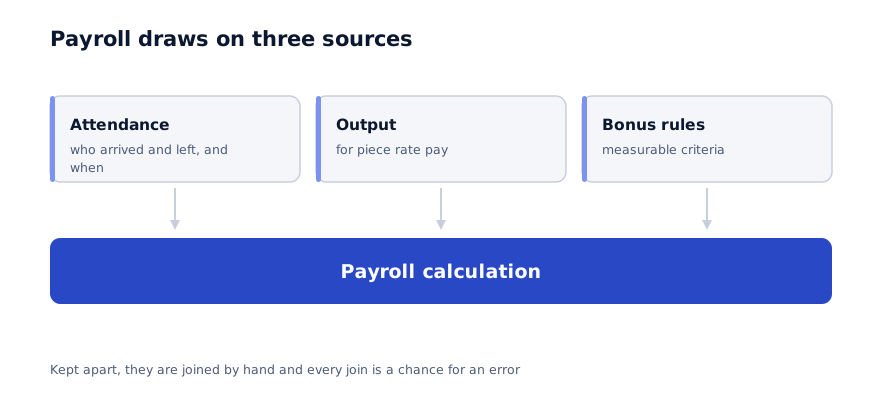
The cause is not the calculation but the data gathering.
Attendance. The timesheet is kept on paper or in a spreadsheet. A department head fills it in at month end, and some days have to be recalled from memory.
Output. On piece rates this comes from the shop floor, usually in a separate book with no link to attendance.
Bonuses and deductions. In a manager's head or a separate sheet. The rules shift slightly every month.
The accountant brings these three together. Every join is a chance for an error, and those errors are what turn into disputes later.
The four most common errors
The timesheet is filled by hand. Arrival times are recorded from memory. Late starts and early finishes usually go unrecorded.
Overtime is unverified. An employee says they worked Saturday and there is no record confirming it.
The bonus rule is undocumented. "Worked well" is interpreted differently every month.
Advances are not carried through. A mid-month payment is forgotten in the final calculation and corrected afterwards.
A practical check: count how many payroll queries you received in the last three months. More than three a month means the problem is not the calculation but the source data.
What the system changes
| What | Now | With a system |
|---|---|---|
| Attendance | Filled by hand at month end | Captured automatically by a terminal |
| Late starts | Not recorded | Visible to the minute |
| Overtime | Confirmed verbally | Confirmed by a record |
| Piece rate output | In a separate book | Arrives from the production module |
| Bonus | Calculated by hand | Applied automatically by rule |
| Employee questions | Go to the accountant | Answered in their own portal |
The last row has an unexpectedly large effect. When employees can see their own hours and calculation, queries drop sharply — because they spot an error the same day rather than at month end.
Attendance capture: three approaches
The choice depends on company size and working conditions.
Cards. Cheap, but a card can be handed to someone else. Control quality is low.
Fingerprint. Reliable, but awkward on a shop floor — hands are dirty or gloved. In catering there is also a hygiene question.
Face recognition. Contactless, fast, and gloves are not an obstacle. In manufacturing and services this is usually the most practical option.
Our own Face ID System works this way and is used by over 20,000 people.
How to define a bonus rule
This is the hardest part, and it is not technical.
If a bonus is paid "for working well", it cannot be automated. The rule has to be measurable.
A working formula:
- Each criterion must be measurable: output, quality, attendance, deadlines
- Each criterion carries a weight: for example output 50%, quality 30%, attendance 20%
- There must be a threshold: below the norm, no bonus applies
- There must be a ceiling, so the budget stays under control
- Exceptions must be written down: illness, leave, enforced downtime
Once the rule exists, entering it into the system is a day's work. Writing the rule can take several weeks — and that is a management task, not a system one.
The most common mistake
Automating an existing mess. If the bonus is calculated differently every month, the system will reproduce the same inconsistency — only faster. Write the rule first, then automate it.
How the rollout runs
01
Attendance terminal
The first step. Data begins to be captured at source. Run in parallel with the old timesheet for a month.
02
Write the rules
Working hours, lateness, overtime, bonus criteria. This is management work and it happens before the system.
03
Calculation module
The rules go into the system. The first month is reconciled against the manual calculation.
04
Link to production
On piece rates, output arrives from the production module automatically.
05
Employee portal
Each employee sees their own hours and calculation. This is where queries fall sharply.
Will staff resist
Yes, and more strongly than on most projects.
The reason is obvious: lateness is now visible. Five minutes that used to pass unnoticed now sit in a record.
What works:
Announce the rules in advance. Before the system is switched on, not after. How lateness is counted and where the threshold sits should be stated openly.
Apply no deductions in the first month. Data is collected but does not affect pay. That gives people time to adjust.
Show the upside. Overtime is now confirmed by a record, which favours the employee. Bonuses follow a rule rather than a manager's mood.
Give the portal early. When employees can see their own data, the system reads as transparency rather than surveillance.
What to measure
| Metric | Starting point |
|---|---|
| Days spent on payroll | Usually two to three |
| Queries per month | Count them and write it down |
| Number of corrections | How many changes follow the first calculation |
| Overtime disputes | How many per month |
The first is the most visible, but the second matters more. Fewer queries is a sign of trust, and it feeds into staff turnover as well.
What it costs
$7,000-12,000On a ready system, with an attendance terminal, 3-4 weeks
$70,000-90,000As a module inside an enterprise system, 14-16 weeks
Terminal hardware is a separate cost and is usually not included in the price. Face recognition terminal pricing varies by model — ask about it separately when you receive a proposal.
In summary
It is not the calculation that takes time, it is the gathering. When the sources sit in one system, the calculation itself takes seconds.
Practical steps:
- Count payroll queries over the last three months — that is your baseline
- Start with the attendance terminal; it captures data at source
- Write the bonus rule — that is management work, not a system task
- Apply no deductions in the first month while data accumulates
- Release the employee portal early — that is when queries fall
Let us review your payroll process
In 30 minutes we identify where the calculation slows down, and you leave with an indicative timeline and budget.
Discuss your project
Shahbozbek Usmonov
ShahNur Software team sharing lessons from building and running real products.
About the teamRelated articles

Automation
Warehouse automation: from the ledger to real time
Why stock figures never match, whether barcodes are actually needed, and how a rollout runs. A practical way to reduce your stocktake variance.
September 2, 20266 min read
Read more
Industry
Digitising a manufacturing operation: where to start
Which module to implement first in a plant, why product costing comes out wrong, and how a rollout actually runs. A practical order drawn from 37.
August 21, 20266 min read
Read more
ERP
How much does an ERP cost in the GCC
What drives ERP pricing, which ranges are realistic, and what to do when the budget does not stretch. A concrete breakdown by modules, integrations and.
August 25, 20266 min read
Read moreHave a product idea? Let’s build it together.
Start a conversationOn this page